NEWS
Inland Empire Leaders Gather to Advance Attainment, Opportunity and Economic Mobility

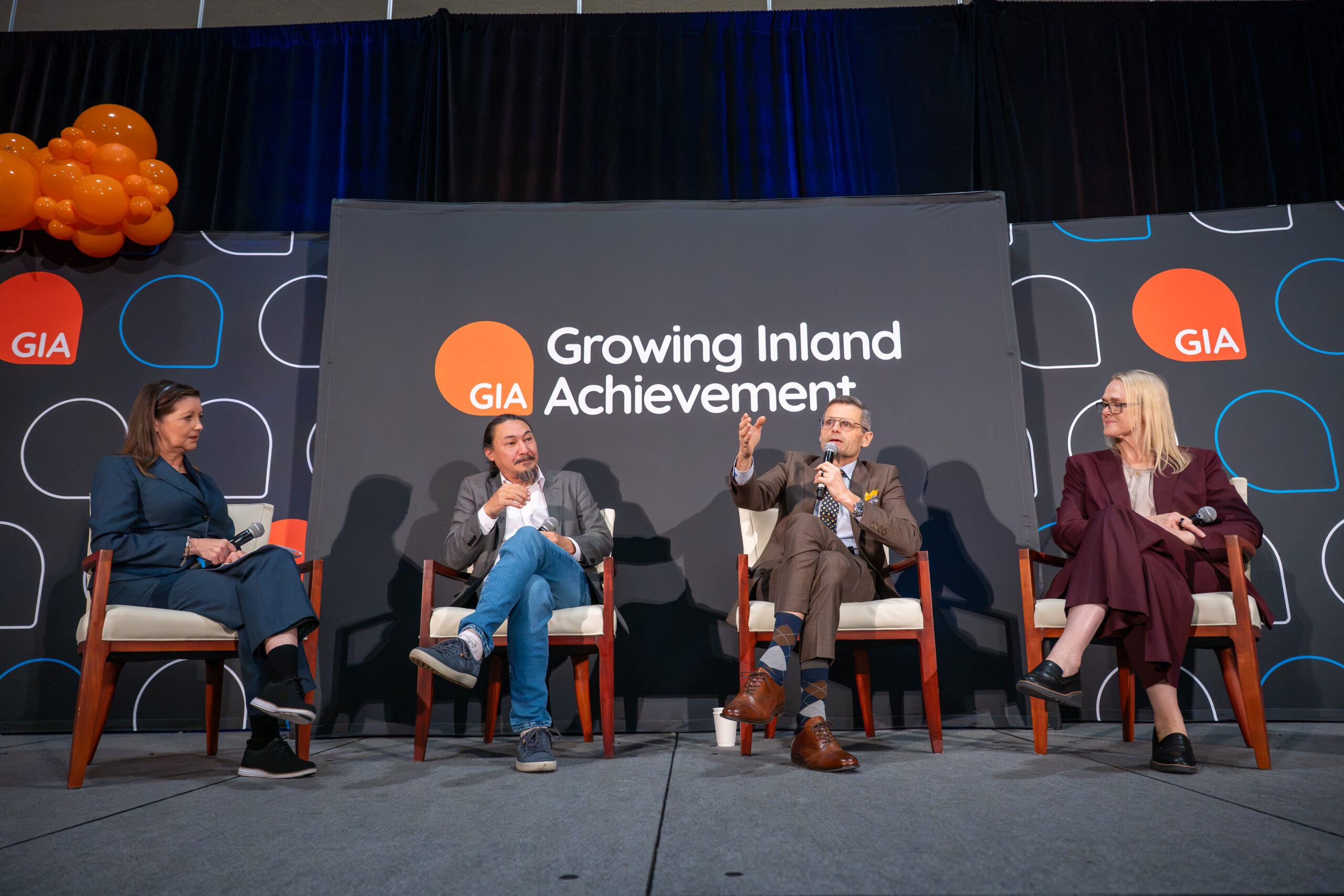
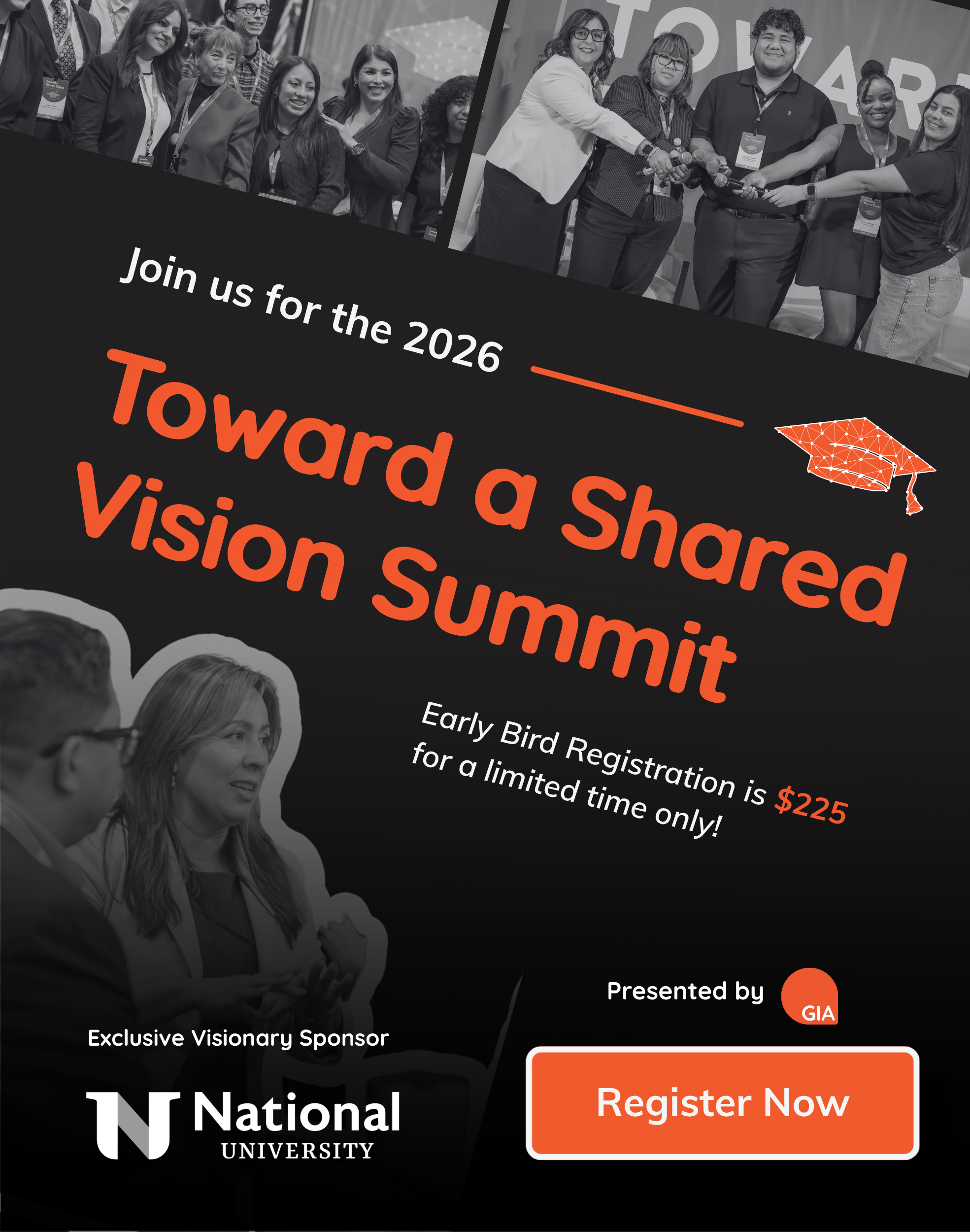
Growing Inland Achievement’s 2026 Toward a Shared Vision Summit brought nearly 300 leaders from education, workforce, business, philanthropy, government and community organizations to Riverside on November 4 and 5 to examine where Inland Empire students lose ground and what the region can do together to change it.
At a Glance
The two-day Summit included a keynote by Maria Flynn, President and CEO of Jobs for the Future; two main-stage conversations with regional leaders; the 2026 Toward a Shared Vision Awards; a special recognition of three longtime education leaders; ten breakout sessions; a live, crowd-sourced lunch conversation; and an opening performance by a student poet.
About Growing Inland Achievement
Growing Inland Achievement (GIA) is the Inland Empire’s regional coordinating intermediary for cradle-to-career attainment and economic mobility. It serves Riverside and San Bernardino counties, a region of more than 4.7 million residents and more than one million students across 27,000 square miles of urban, suburban and rural communities.
GIA works with leaders from 56 K-12 school districts, 12 community colleges, six universities and dozens of nonprofit and industry partners. It uses a collective-impact framework to connect systems that do not always work together, reduce duplication and help partners turn shared goals into coordinated action. Its strategy is known as CAIR: GIA convenes leaders, advocates for equitable systems and policy change, invests in what works, and produces research and data that partners use to make decisions.
GIA’s north star goal mirrors California’s statewide goal: 70% of working-age adults (ages 25 to 64) holding a postsecondary degree or credential of value, with a focus on equity and real economic mobility.
Why the Summit Matters
The Inland Empire is one of California’s fastest-growing regions, but educational attainment and incomes lag the state. Data presented at the Summit showed that:
- Of every 1,000 Inland Empire ninth graders, 262 are on a pathway to a bachelor’s degree, compared with 351 in the rest of California.
- 57% of Inland Empire high school seniors enroll in college, compared with 65% statewide.
- 32% of the region’s transfer-intending community college students transfer to a four-year university within six years, compared with 40% statewide. All 12 Inland Empire community colleges have transfer rates below the state average, and six of the 12 are 25 or more miles from the nearest University of California or California State University campus.
- Nearly 722,000 Inland Empire adults have some college but no degree.
- 57% of young adult households in the region do not earn enough to meet the Self-Sufficiency Standard.
- 67% of jobs statewide will require education or training beyond high school by 2031.
Reaching 70% attainment across all groups in the Inland Empire would generate an estimated $1 trillion in long-term economic gains for California, the largest contribution of any region in the state. The Summit is GIA’s annual opportunity to put that data in front of the people who can act on it, and to align their work.
Sources: Public Policy Institute of California (PPIC), Pathways to College Completion in the Inland Empire (2025); U.S. Census Bureau, American Community Survey 1-Year (2025); as presented by GIA at the Summit.
Day 1: Wednesday, November 4
Pre-Summit activities
The day began with a full-day workshop, Making Labor Market Data Work for You, followed by meetings of GIA’s Action Network Teams, which bring partners together year-round around shared regional priorities, and a meeting of the GIA Board of Directors.
Opening reception and welcome
The Summit opened that evening with a reception and live music. Dr. Ashish Vaidya, President and CEO of GIA, welcomed guests and thanked National University, the Summit’s Exclusive Visionary Partner, and its other sponsors before dinner.
Fireside chat: “The Power of Us: Leading Through Partnership”
Ted Alejandre, San Bernardino County Superintendent of Schools, and Michelle Decker, President and CEO of the Inland Empire Community Foundation, joined Dr. Vaidya for a conversation about what partnership requires when the region’s challenges cross institutional and sector lines. The discussion focused on shared responsibility for the region’s future and what it will take to accelerate progress toward 70% attainment.
The 2026 Toward a Shared Vision Awards
The awards, framed around GIA’s core values, recognize people and organizations advancing educational attainment and opportunity in the region. Ann Marie Sakrekoff, GIA’s Chief Operating Officer, opened the ceremony. Dr. Vaidya and GIA Board Chair Dr. Diana Z. Rodriguez, Chancellor of the San Bernardino Community College District, presented each award, and a short tribute video told each honoree’s story.
| Award | Recipient |
|---|---|
| Excellence in Transformation | Dr. Gwen Dowdy-Rodgers, President and CEO, Arrowhead United Way |
| Excellence in Innovation | Dr. Stephanie Houston, Assistant Superintendent of Innovation and Engagement, San Bernardino County Superintendent of Schools |
| Excellence in Accountability | Emily Rupp, Copper Mountain College |
| Excellence in Equity | Foster Youth Student Empowerment Program, Riverside County Office of Education |
| Excellence in Collaboration | Riverside Community College District and the University of California, Riverside (RCCD-UCR Residential Scholars Program) |
In Honor of Visionary Leadership
GIA also honored three leaders whose years of service have shaped education and opportunity across the Inland Empire: Ted Alejandre, San Bernardino County Superintendent of Schools; Dr. Wolde-Ab Isaac, Chancellor of Riverside Community College District; and Dr. Henry Shannon of Chaffey College. Each honoree received the recognition on stage and addressed the room. Ann Marie Sakrekoff closed the evening.
Day 2: Thursday, November 5
A student voice opens the day
Day 2 began without an introduction. Jessica Zenteno, a Riverside City College alumna, graduate student at the University of Redlands and College Corps Alumni Leader, performed an original spoken-word piece that set the tone for a day centered on students.
Welcome and State of the Region
Dr. Vaidya presented the State of the Region, tracing the student journey from ninth grade through college and into the workforce and showing where Inland Empire students fall behind state averages. He highlighted the transitions that matter most: from high school to college, through community college transfer, and back to school for working adults. He illustrated them with the stories of three students: a ninth grader, a community college student and a returning adult learner. He also reported on GIA’s work since the 2025 Summit, including more than 500 convening participants, more than 100 external engagements, more than $1.5 million in new grants awarded to GIA and five research publications.
He closed with a question for the room: “Are you going to be the one who helps?” He challenged partners to make the pathway from school to career more visible, navigable, accessible and valuable, ending with the line “Our goal is 70%. Our purpose is economic mobility.”
Keynote: “Building the Future of Opportunity”
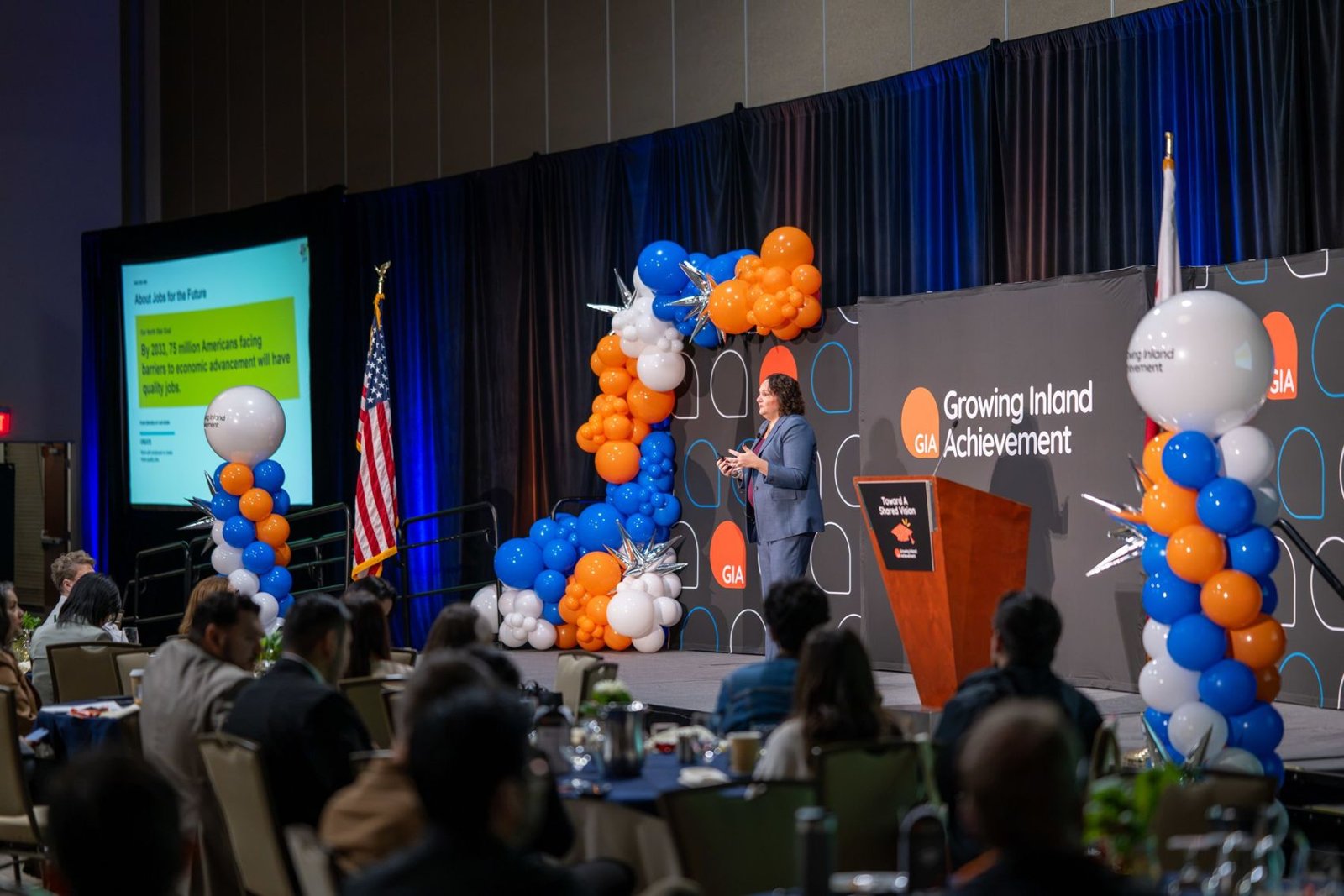
Maria Flynn, President and CEO of Jobs for the Future (JFF), a national nonprofit focused on transforming education and workforce systems, delivered the keynote, asking where the country is headed and what regional systems are needed now. Flynn argued that the region faces “a systems-design problem,” not a talent problem. Points from her presentation included:
- California has an estimated $4.4 trillion in untapped economic potential, about $214,000 per working adult, and roughly $1 trillion of that potential is in the Inland Empire.
- In a national JFF survey of registered voters conducted with Morning Consult, 81% said job quality should be a priority for elected officials; only 39% said they were confident that young people leave high school prepared for a career; and 38% of young people said they were not ready for an AI-shaped economy.
- Only about four in 10 U.S. workers hold quality jobs.
Flynn outlined JFF’s “No Dead Ends” approach: recognize and accelerate learning, including credit for prior learning; connect learners to opportunity through career navigation, credentials of value and work-based learning; and build the social connections that sustain mobility. Flynn closed with audience questions.
Keynote data as presented by Maria Flynn, Jobs for the Future.
Breakout sessions
Ten breakout sessions, held in two rounds, featured presenters from colleges and universities, school districts, county offices of education, workforce and economic development organizations, philanthropy and industry.
| Session 1 (morning) | Session 2 (afternoon) |
|---|---|
| Building the IE’s Cyber Talent & Ecosystem | Building Regional Resilience: Energy Workforce Partnerships in the Inland Empire |
| Connecting Student Talent to Industry Need: Building Partnerships for Career Success and Economic Mobility | Building Toward the North Star: GIA’s Role in the Higher Endeavor Ecosystem |
| From First Year to First Job: A Replicable Career Readiness Pathway at CSUSB | One Region, One Talent Pipeline: Making Inland Empire Early Talent Easier to Recruit |
| Increasing A-G to Improve Access and Opportunity in the Inland Empire | Building Workforce Development Pipelines for Adult Learners |
| Place, Pace, Pathway, People: Designing College Around Adult Learners | Building Purposeful Pathways: What It Takes to Connect High School, College, and Career |
Lunch and regional conversation
During lunch, attendees answered one question by scanning a QR code: “If the Inland Empire could take one bold action to advance educational attainment, opportunity, and economic mobility, what should it be?” GIA turned the responses into an on-screen word cloud in real time. Frances Tapper, GIA’s Director of Postsecondary Success, summarized four themes that emerged:
- Make college affordable, even free. The most common response.
- Bring better jobs to the region. Attract new industries, support small business and entrepreneurship, and move beyond a warehouse-driven economy.
- Remove barriers for learners. Help adults with some college finish, and support student parents with child care and emergency aid.
- Lead and invest together as a region. Convene across sectors, build leadership that brings state resources to the Inland Empire, and fund what works.
Three regional leaders then responded to the room’s ideas. The survey remains open so the conversation can continue.
Remarks from the Exclusive Visionary Partner
Dr. Nicole C. Polen-Petit, Dean of the School of Arts, Letters & Sciences and Regional Vice President for the Inland Empire at National University, addressed attendees on behalf of the Summit’s Exclusive Visionary Partner.
Closing conversation: “The Moment Is Ours: Leadership, Vision & What Comes Next”
Dr. Monica Green, President of Norco College, moderated a closing conversation with Dr. Wendy A. Cortez, Chief Operating Officer of Kaiser Permanente Ontario Medical Center; Dr. Anthony Hilliard, President and Chief Executive Officer of Loma Linda University Health; and Kaina Pereira, Executive Director of the California Workforce Development Board. The panel brought perspectives from health care, higher education and state workforce policy to a discussion of leadership, accountability and turning shared ambition into progress.
Closing and networking
Ann Marie Sakrekoff closed the Summit, thanked speakers, sponsors and attendees, and invited participants to complete a feedback survey before a networking social.
Who Attended
Registrants represented more than 70 organizations from 36 cities, seven states and Washington, D.C. Among registrants who identified their sector, 47% came from postsecondary education, 31% from nonprofits, 11% from K-12 education, 5% from business and consulting, 3% from philanthropy and 3% from government. Participation from government, business, philanthropy and workforce-focused organizations grew compared with 2025, reflecting the Summit’s cross-sector purpose.
What Participants Said
Of 80 post-Summit survey respondents, 97% rated the event Excellent, Very Good or Good, and 89% rated it Excellent or Very Good. Comments included:
Value to the Region
- A shared set of facts. The Summit put regional data on college-going, transfer and adult learners in front of leaders across sectors, giving them a common starting point for decisions.
- Connections across systems. K-12 districts, community colleges, universities, employers, philanthropy and government leaders met in one room. Most of these institutions rarely plan together, yet students move through all of them.
- National ideas, regional application. The JFF keynote connected national research on job quality, AI and career readiness to the Inland Empire’s specific challenges and economic potential.
- Practical strategies. Ten breakout sessions shared working models, from career readiness pathways and A-G course access to adult learner design and energy workforce partnerships, that other institutions can adapt.
- Recognition of what works. The awards highlighted people and programs producing results, from foster youth support to university-community college partnerships.
- Community input. The live lunch conversation captured participants’ priorities for bold regional action, which GIA will use in its ongoing work.
What Comes Next
GIA will publish a Summit Summary Report and session videos for its network. Partners are invited to join GIA’s Action Network Teams, use GIA’s research and data, and work with GIA to align their efforts with the region’s shared goal of 70% attainment.
Sponsors
Exclusive Visionary Partner: National University. Collaborators: California Baptist University, California State University San Bernardino, Insperity, San Bernardino Community College District and University of California, Riverside. Supporters: Big Brothers Big Sisters of Orange County and the Inland Empire, Inland Empire Economic Partnership, IEHP Foundation, Riverside County Supervisor Karen Spiegel, OneFuture Coachella Valley, Riverside Community College District and Riverside County Office of Education. Friends: Advising Success Network, Altura Credit Union, Chaffey College and San Bernardino County Superintendent of Schools.
UPCOMING EVENTS
RECENT NEWS
- Inland Empire Leaders Gather to Advance Attainment, Opportunity and Economic Mobility
- Award-Winning PBS Documentary The Class Comes to the Inland Empire for Special CSUSB Screening
- From Insight to Action: Key Takeaways from Our Golden Ticket
- What California’s Historic Education Budget Means for the Inland Empire
- Growing Inland Achievement Receives Grant to Strengthen Purposeful Pathways in the Inland Empire